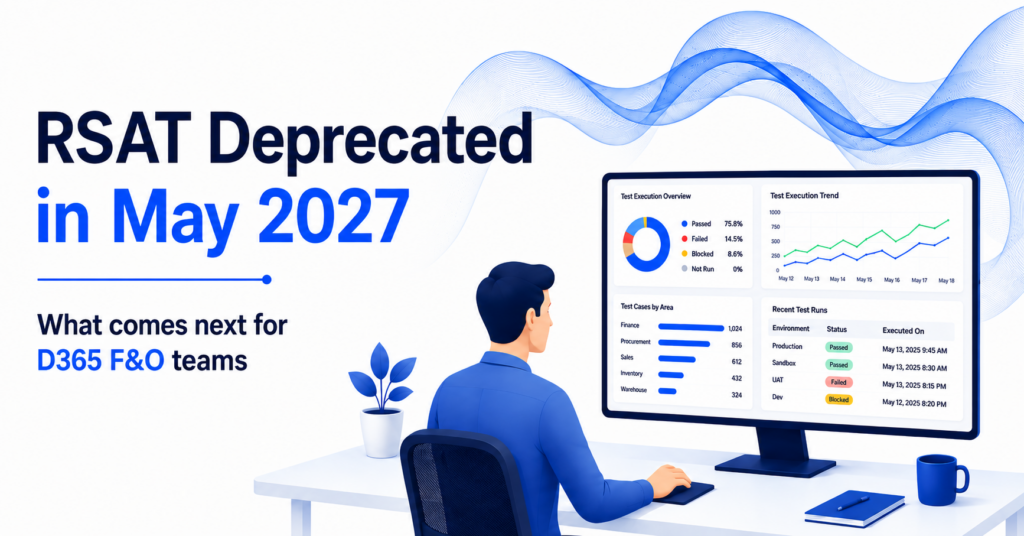
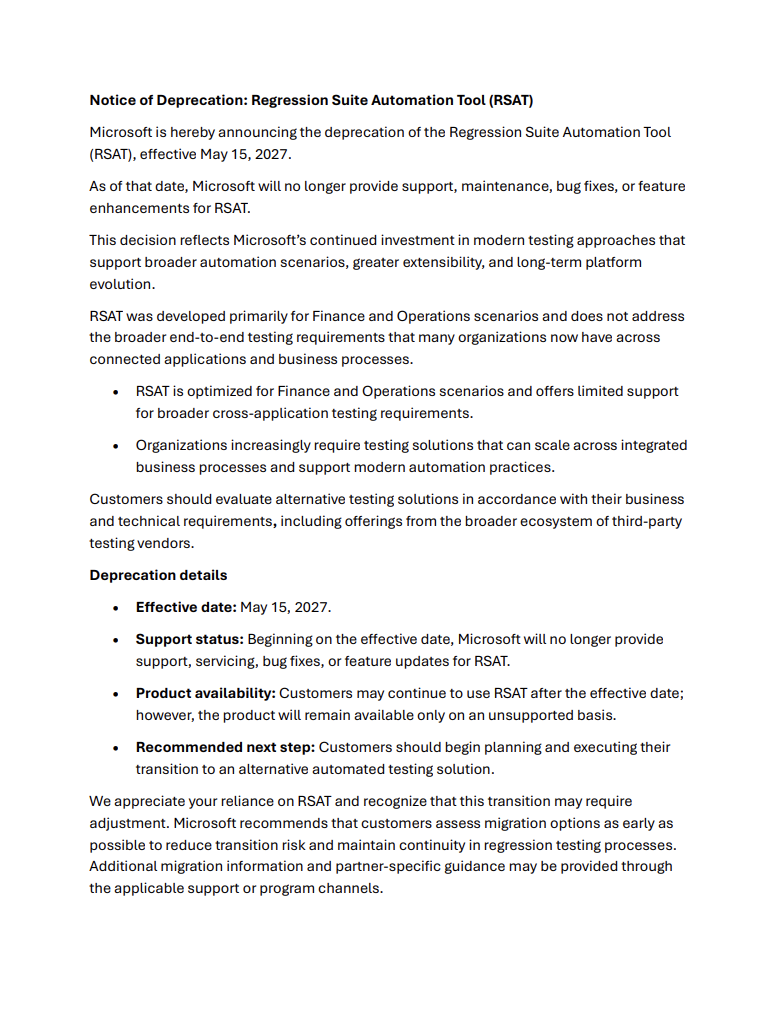
Microsoft has officially announced the deprecation of the Regression Suite Automation Tool (RSAT), effective May 15, 2027. As of that date, Microsoft will no longer provide support, maintenance, bug fixes, or feature updates for RSAT. The tool will remain available after the deadline, but entirely on an unsupported basis.
Microsoft’s official notice is direct about the reasoning: RSAT was built primarily for Finance and Operations scenarios and does not address the broader end-to-end testing requirements many organizations have today across connected applications and business processes. Microsoft is recommending that customers begin evaluating alternative testing solutions now, and start planning their transition as early as possible to reduce risk and maintain continuity.
Microsoft Deprecating RSAT: Key Facts at a Glance
- Effective date: May 15, 2027
- What ends: All Microsoft support, bug fixes, and feature updates
- What remains: The tool stays available but fully unsupported
- Microsoft’s recommendation: Begin evaluating and transitioning to an alternative automated testing solution as early as possible
What the RSAT Deprecation Means for D365 Finance and Operations Teams
For D365 Finance and Operations and Supply Chain Management teams, RSAT has served a real purpose. It gave organizations a way to build regression coverage without requiring dedicated automation engineers. Teams that used it well built meaningful libraries: recorded business processes mapped to real workflows, organized subtasks, parameterized test data. That represents years of institutional knowledge.
The challenge RSAT never fully solved was the maintenance cost that came with it. Every Microsoft wave release brings UI changes across F&O and SCM. When forms reorganize or fields shift, recorded tests break. Someone has to find and fix them manually. For teams with large libraries, this has been a predictable, recurring drain every release cycle.
That cost does not go away on its own. And with RSAT now heading toward end of support, the decision to move on is no longer optional. It is a matter of timing.
Replacing RSAT: Why Picking a New Tool Is the Wrong First Step
Organizations that have invested in RSAT over multiple years have encoded real business logic in those scripts. The process flows, the risk scenarios, the edge cases from past go-lives and period-close failures. That work represents genuine institutional knowledge, and it does not have to be left behind.
The good news is that migrating off RSAT does not mean starting from zero. The right migration path carries what you have already built forward, preserves the business logic, and eliminates the UI dependency that made those tests brittle in the first place. Teams that approach it that way come out of the migration with stronger coverage than they had going in, not less.
TheTestMart: A Purpose-Built RSAT Alternative for D365 F&O
TheTestMart was built specifically for the Microsoft Dynamics 365 ecosystem, with a focus on Finance and Operations and Supply Chain Management. Not a generic automation framework adapted for D365. Purpose-built for it.
For teams migrating off RSAT, our platform includes the ability to bring your existing test library forward rather than rebuild from zero. Your recorded business processes, your workflow logic, your parameter sets — they carry over. What changes is the underlying architecture: one designed to handle the ongoing wave release cadence without the manual re-recording cycle that RSAT required.
We also work with Microsoft partners who need a repeatable validation approach they can deploy across client environments during implementations. If RSAT has been part of your delivery methodology, this transition affects your practice too, not just your end customers.
How Long Does an RSAT Migration Take? Start Now, Not in Q1 2027
Microsoft’s guidance is to begin planning now. We agree. The organizations that start their migration assessment in the next few weeks will have time to do this properly: evaluate coverage gaps, run a conversion process, validate against a real wave release, and get operationally ready before the deadline.
The organizations that wait until late 2026 will be navigating a migration in the middle of go-lives, upgrades, and period closes.
If you want to understand what your current RSAT footprint looks like and what a transition to TheTestMart would involve, we are offering migration assessments now. We will walk through your library, identify your highest-risk gaps, and show you a clear path forward.
Schedule a RSAT Migration Assessment Here